"[There is] a radical difference between interior and exterior, which relfects the split between the intimate and the social life of the metropolitan being: outside, the realm of exhange, money, and masks; inside, the realm of the inalienable, the nonexchangeable, and the unspeakable."
(The Architecture of Fashion, p.210)
This is another beautiful quote that is used to describe architecture but can unquestionably be applied to fashion and modesty in Islam.
I especially enjoy the way the quote describes the "inside", "the realm of the inalienable, the nonexhangeable, and the unspeakable". I wonder what thoughts this invokes in you because for me, the inalienable, the nonexhangeable, and the unspeakable in realtion to our private lives is a beautiful thought for me. The unspeakable is not a negative thing; something which is so beautiful, one would not dare to articulate its beauty in fear that words could not do it justice.
29 December 2009
The Realm of the Unspeakable
28 December 2009
Protecting Sexuality in Design
"a cauldron of sexuality behind apparently innocent surfaces"
(The Architecture of Fashion p.198)
Personally, when I read this quote, I automatically thought of the designs of many courtyards in the United Arab Emirates. The exterior facades or "innocent surfaces" hide and protect the beautifully decorated interior designs.

The arabesque designs and flowing tile work can be associated with the "cauldron of sexuality" that the quote suggests.
Similarly to architecture, the concept of the hijab can also be related to this quote. A "innocent surface" of basic cloth behind the "cauldron of sexuality" which, to me, is a beautiful description of women. Describing sexuality as powerful and beautiful thing that is protected by an "innocent surface".
I also want to note that I took this quote from the book, The Architecture of Fashion, and this book does not talk about fashion and architecture of the Middle East. It focuses more on design in the West. This is important to note because I want to emphasis the fact that our concepts of sexuality, and protecting it is not unique to any part of the world. It is a shared view, different cultures have evolved to express this in different ways.
26 December 2009
Women's Barrier in Mosques

Rayan, the Muslimah feminist character, feels that there is no need for a wall and that having the women sit in the back of the prayer hall is a sufficient barrier.
In the end, there is a partition wall constructed but it is smaller, with a slight screen, and women have the choice to either site behind it or sit to the side of it.

It is an interesting compromise. What do you think about the physical partition in mosques?
24 December 2009
Islamic Costume/Facade

18 December 2009
Book Recommendation: Architecture in Fashion
 This book is very inspiring to my whole intention for this blog. Although the essays in this book speak mostly about western architecture and its relationship to western fashion, the theories are still applicable.
There are numerous quotes from this book which continue to inspire me and will be the premise for many of my future posts.
17 December 2009
Istanbul- The Silhouette
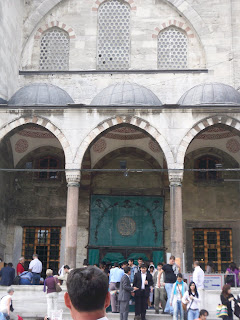 While visiting the Blue Mosque in Istanbul, Turkey, I noticed an interesting combination of fabric and architecture. Covering one of the main doors of the mosque is a plastic tarp that is used to create a smaller doorway (as opposed to the original 7 meter tall door). The need for a smaller opening is probably to keep birds out of the prayer hall as well as to protect against rain.
The interesting aspect of this piece of fabric is the way they chose to accent the original frame of the door with a floral design.
The green color of the tarp is very prominent and makes a very distinct impression on the overall aesthetic of the mosque.

15 December 2009
Modesty of Architecture- Form and Facade
Modesty can be expressed in many different ways and, of particular interest to me is how it is applied to Architecture.
Similar to clothing, the form of a building expresses a lot about a place and can look particularly extravagant or simple.
I want to look at two examples of architecture in the Arabian gulf, the Islamic Art Museum in Doha and the Sheikh Zayed Mosque in Abu Dhabi. Both of these buildings are associated with Islam and the representation of each countries culture.
How do you feel about ornamentation on buildings? Do buildings need to be modest when representing Islam?


14 December 2009
Book Recommendation: The Fashion of Architecture
The Fashion of Architecture by Bradley Quinn
This is the book which was referenced in yesterday's posting:
"Architecture is making its presence felt in cutting-edge fashion. The pliable metals, membrane structures, lightweight glasses and plastics used in building construction are creeping onto the catwalk. As they do so, their impact on recent textile developments has produced fabrics that enable clothing to act as individual climate-controlled environments that can exchange information with embedded sensors, resulting in wearable ‘dwellings’ that act as both shelter and clothing. At the same time, architects are borrowing the techniques of pleating, stapling, cutting and draping from traditional tailoring to design buildings that are flexible, interactive, inflatable and even portable."
10 December 2009
Introduction to Modesty In Vogue
This blog is intended to discuss issues about Modesty and Design, particularly in fashion and architecture in relation to Islam and Islamic culture.
Some people may ask how I can discuss these four things in one blog (modesty, fashion, architecture, and Islam) and that is a reasonable question.
For one, Fashion and Architecture are both intimately related through design. Fashion is the design of clothing to protect the body and Architecture is the design of a structure to shelter and protect space. These two types of design are both used as a basic part of life but are also representative of an idea, culture, personal image, and function.
Secondly, Modesty, or Haya in Islam is a basic part of life in Islamic culture and can be exhibited in many different ways but most notably in behavior and even dress. The hijab is a primary example of how women in Islam represent their modesty. Modesty can also be exhibited through other forms of dress but also architecture. When talking about modesty in architecture, especially in Islamic societies, one can image the traditional courtyard houses of the Arabian Gulf where the walls and exterior facades of buildings are minimal and purely functional while the interior of the buildings are decorated in ornate tile work.
Throughout this blog, I don't always plan on discussing all four things at once in every post, but my main focus is on how we represent our Modesty or Haya in relation to design and our aesthetic world.


